
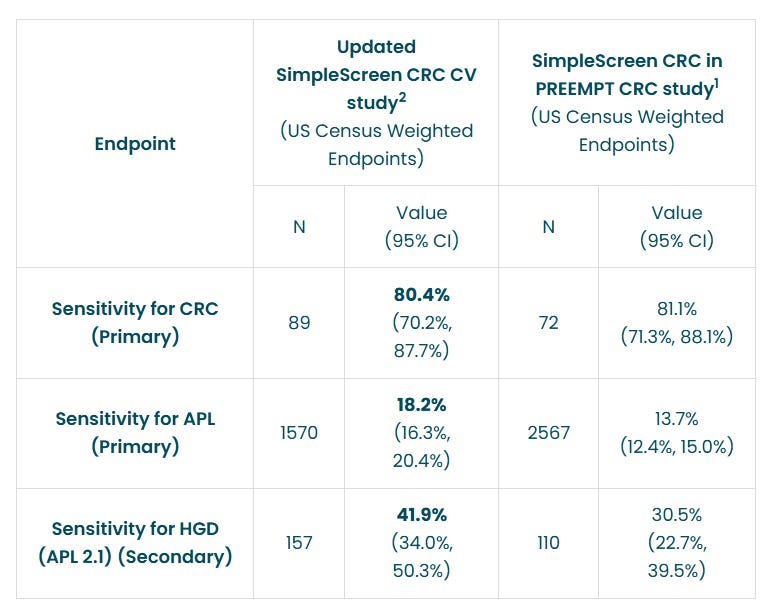
Freenome's updated sensitivity values for their SimpleScreen CRC assay
Updated test version achieved significant performance improvement in detecting advanced precancerous lesions, including those with high-grade dysplasia

The updated clinical validation data for Freenome’s SimpleScreen CRC test is another page in the book of Early Cancer Detection using NGS and Multiomics. By meeting its primary and secondary endpoints, the multiomics test achieved an overall colorectal cancer (CRC) sensitivity of 80.4% alongside a specificity of 90%. While the overall sensitivity represents a slight numerical dip from their previously reported investigational benchmark of 85%, the true breakthrough lies in the test’s ability to detect precancerous lesions, addressing the historical Achilles’ heel of blood-based diagnostics.
Bridging the Precancerous Gap
Historically, stool-based tests like Exact Sciences’ Cologuard and Geneoscopy’s ColoSense have dominated the non-invasive screening market due to their high CRC sensitivity (hovering around 93% to 94%) and their robust ability to detect precancerous polyps at 43% to 45%. Blood tests, while highly attractive to patients who refuse stool tests or colonoscopies, have traditionally struggled with precancer detection. For instance, Guardant Health’s FDA-approved Shield test yields a precancer sensitivity of only 13%.
Freenome’s updated SimpleScreen brings another player to this field. The test achieved an 18.2% sensitivity for advanced precancerous lesions (APLs) and an impressive 41.9% sensitivity for APLs featuring high-grade dysplasia (HGD). Detecting high-grade dysplasia is critical because these specific lesions carry the highest risk of progressing to full-blown CRC if left untreated. According to Freenome’s published models, this enhanced precancer detection translates to 1,582 additional life-years gained and 143 fewer CRC deaths per 100,000 screened individuals compared to their first-generation assay. This bridges the performance gap between patient-preferred blood tests and clinically entrenched stool tests, positioning Abbott/Exact, who are Freenome’s commercialization partners, to offer a highly competitive diagnostic tool once FDA review concludes in mid-2026.
The Targeted vs. MCED Paradigm
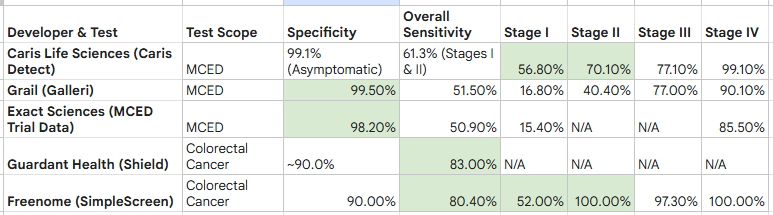
This targeted, disease-specific breakthrough also highlights the diverging strategies within the broader Multi-Cancer Early Detection (MCED) space. Companies like Grail and Caris Life Sciences utilize pan-cancer approaches designed to cast a wide net. While tests like Galleri boast an extraordinary specificity of 99.5% for broad screening, they struggle with early-stage sensitivity for individual cancers, detecting only 16.8% of Stage I cases across their cohorts.
By contrast, Freenome’s CRC-focused approach proves that with the right algorithmic training on a specific disease pathway, the yields rise substantially for early-stage detection. SimpleScreen identified 52% of Stage I CRC cases, 100% of Stage II, 97.3% of Stage III, and 100% of Stage IV. Freenome will say that this proves that while MCEDs are valuable for broad population risk assessments, purpose-built assays remain the superior non-invasive choice for specific, highly actionable cancers like CRC. Furthermore, Freenome’s strategy to bundle SimpleScreen CRC with a lung cancer screening test indicates a strategic pivot toward personalized, multi-indication testing rather than generalized pan-cancer screening.
The reaction
Clinicians are pointing out that a blood-based test capable of hitting a 41.9% sensitivity for high-grade dysplasia is a major victory. On medical news hubs like HCPLive and Targeted Oncology, commentaries from independent gastroenterologists emphasize that catching nearly 42% of the highest-risk precancerous polyps represents the first time a liquid biopsy has legitimately threatened the clinical moat established by stool-based tests. The consensus is that this narrows the “prevention gap,” making it a highly viable option for the 50 million unscreened Americans who routinely refuse stool kits or invasive colonoscopies.
Here is an updated version of the assays and their performance:

And for MCED vs CRC below:
Strategic Positioning
In the lines below, I’ll react to the news from Freenome and chart out what possible moves we could see in the field in the next few months.
