
Sera Prognostics Company Profile
Are we moving into a new world where Multiomics and AI can help develop diagnostic tests in a fraction of the time than before?

Sera Prognostics, Inc. (Nasdaq: SERA SERA 0.00%↑ ) is a health diagnostics company focused on maternal and neonatal care through the discovery and commercialization of blood-based biomarker tests. The company’s primary offering is the PreTRM test, a proteomic blood test administered during weeks 18 through 20 of pregnancy. PreTRM measures specific protein biomarkers in maternal blood to assess the individualized risk of spontaneous preterm birth in asymptomatic, singleton pregnancies.
The Biomarkers: The core of the PreTRM test relies on measuring a specific ratio of two proteins found in a pregnant person's blood between weeks 18 and 20 of gestation: IBP4 (Insulin-like Growth Factor Binding Protein 4) and SHBG (Sex Hormone Binding Globulin). Sera Prognostics holds patents (such as WO2016205723A2 - Biomarker pairs for predicting preterm birth and its US equivalents) that specifically protect the use of these paired biomarkers for predicting preterm birth. The patents also cover the clinical methodology—using targeted proteomics to measure these specific proteins and the algorithms used to calculate an individualized risk score for spontaneous premature delivery.
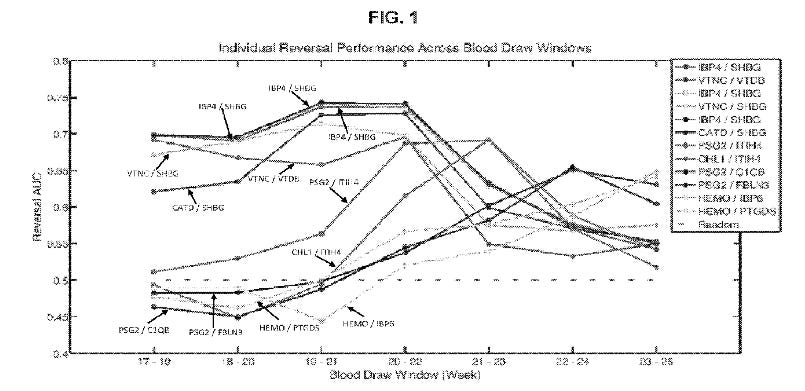
By providing this individualized risk assessment, the company aims to enable clinicians to implement targeted interventions that can improve neonatal outcomes and reduce healthcare costs associated with premature deliveries.
Recent Clinical and Commercial Developments
The company recently published a subgroup analysis from its PRIME study in The Journal of Maternal-Fetal & Neonatal Medicine, focusing specifically on first-time pregnancies. This analysis indicated that combining PreTRM risk stratification with targeted clinical interventions yielded measurable improvements in neonatal outcomes compared to routine prenatal care. First-time pregnancies represent 40% of all pregnancies and carry a statistically higher risk of preterm birth than pregnancies following a prior full-term delivery. Traditional risk assessment often relies on a history of preterm delivery, which is inherently inapplicable to first-time mothers. This study strengthens the clinical rationale for the PreTRM test and supports broader payer coverage and physician adoption. Notably, Illinois recently enacted a mandate for Medicaid coverage of proteomic tests assessing the risk of spontaneous preterm birth, setting a precedent that other states may follow.
Comparison with Natera and Traditional Prenatal Assays
Sera Prognostics operates in a different diagnostic space than companies like Natera, which is known for its Panorama non-invasive prenatal test (NIPT). Natera’s Panorama analyzes cell-free placental DNA in the maternal bloodstream as early as nine weeks of gestation to screen for fetal chromosomal conditions such as Down syndrome, Edwards syndrome, and specific microdeletions. While Natera and similar companies focus on genomic analysis to detect inherited or de novo genetic abnormalities in the fetus, Sera Prognostics uses proteomic analysis to predict physiological events related to the mother’s pregnancy timeline.
The Value of Preterm Diagnostics vs. Genetic Screening
The clinical value of preterm birth diagnostics complements traditional genetic screening rather than competing with it. Assays like Natera’s Panorama provide necessary information for genetic counseling and early clinical preparation for infants born with chromosomal conditions. However, preterm birth remains a prominent cause of neonatal morbidity and mortality, affecting pregnancies regardless of the fetus’s genetic health.
Diagnostics like the PreTRM test address a structural gap in prenatal care by identifying physiological risk factors that standard anatomical ultrasound and genetic screens cannot detect. Because spontaneous preterm delivery can often be delayed through medical intervention and care management, early risk identification directly alters the clinical management of the pregnancy. For first-time mothers lacking a reproductive history, these proteomic diagnostics offer a functional tool for reducing neonatal intensive care admissions and complications associated with early delivery.
How NIPT Works
Non-Invasive Prenatal Testing (NIPT) is widely considered a breakthrough in prenatal care because it achieves near-diagnostic accuracy without posing any physical risk to the pregnancy.
Here is exactly how the science works and what the accuracy numbers mean.
NIPT is often described as a “liquid biopsy” of the placenta. Rather than physically testing the baby, it relies on how the baby’s support system interacts with the mother’s body.
Placental Shedding: As the placenta grows, its outer cells naturally break down and release microscopic fragments of genetic material into the mother’s bloodstream. This is known as cell-free fetal DNA (cffDNA).
The Blood Draw: A standard blood draw taken from the mother’s arm (usually anytime after 9 or 10 weeks of pregnancy) captures a mixture of her own DNA and the placental cffDNA. For the lab to successfully run the test, the “fetal fraction”—the percentage of DNA in the sample that comes from the placenta—usually needs to be at least 4%.
Sequencing and Counting: In a laboratory, specialized machines sequence millions of these DNA fragments. The lab’s software maps each piece of DNA to its corresponding chromosome and counts the totals.
Spotting the Anomaly: Humans typically have two copies of chromosome 21. If the lab’s algorithms detect a statistically significant surplus of chromosome 21 fragments in the blood sample, it flags the pregnancy as “high risk” for Down syndrome (Trisomy 21).
The accuracy of NIPT assays for the detection of Down Syndrome has improved in recent years, and now is at the 2nd or 3rd decimal point in Sensitivity and Specificity.
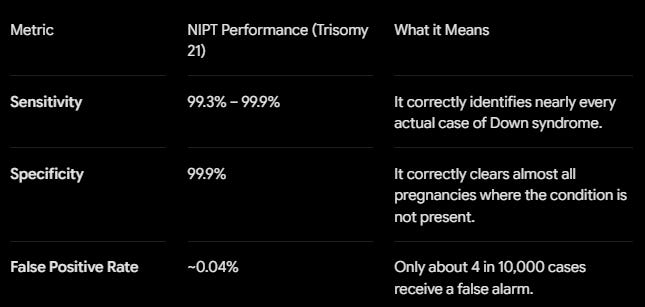
NIPT also screens for Edwards syndrome (Trisomy 18) and Patau syndrome (Trisomy 13), though its sensitivity for those conditions is slightly lower (around 97%).
In rare instances, the Down Syndrome screening will give a False Positive, mostly due to a rare condition called confined placental mosaicism. This means the placenta developed with a chromosomal abnormality (like an extra chromosome 21), but the fetus is completely chromosomally normal. The NIPT accurately reads the placenta's DNA, but falsely assumes the baby shares it. Because of this limitation, a "high-risk" NIPT result is never considered a final diagnosis. Medical guidelines dictate that any major medical decisions must wait until the result is confirmed by a true diagnostic test.
Down Syndrome diagnostics in Europe
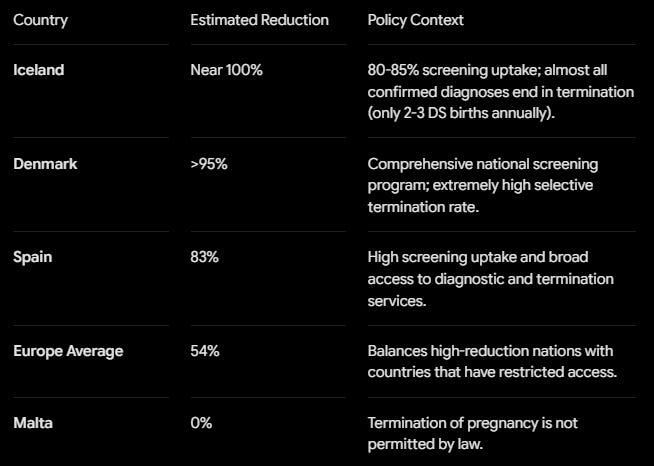
In recent years, the intersection of advancing maternal age and widespread prenatal screening has created a unique demographic shift in Europe. The actual number of babies born with the condition has significantly decreased in recent years, even though the total number of pregnancies affected by Down syndrome has steadily increased—primarily because women are having children later in life.
Reduction in Birth Rate for Down Syndrome
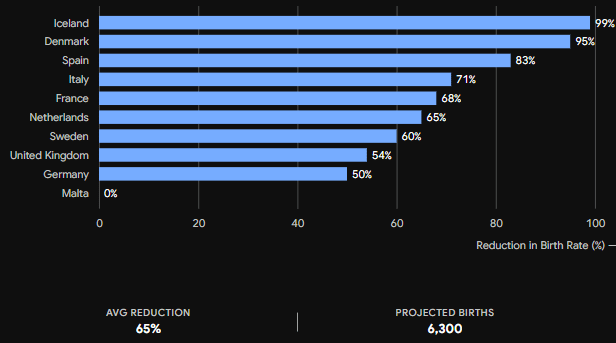
Malta is an example of a country where termination of pregnancy is not permitted by law.
Strategic Positioning
Prenatal testing embraced Genomics Diagnostics quite early on, even before Whole-Genome Sequencing (WGS) became so affordable that it displaced other earlier iterations of the Genomics tools, like microarrays. Natera NTRA 0.00%↑ was quite successful in capitalizing on the potential of Next-Generation Sequencing (NGS) for Prenatal testing, and the company later also embraced Cancer Diagnostics where they are also making a lot of money. In the lines below, I’ll give my prediction on where the Prenatal testing field is moving in the next few years.
